
Shame

The best explanation I have heard for shame is a simple acronym: 
Should 
Have 
Already 
Mastered 
Everything

It’s the feeling that tells us to figure things out on our own. Don’t ask for help. Don’t admit weakness or needs. Keep the facade up, act like you know what the topic of conversation is about. Shame is a master at keeping secrets (where addictions come from). It will hold you in hiding until you feel like you’re enough. When you’re supposed to be a master of everything, there’s no grace or forgiveness for messing up anything.

On the flip side, shame tells us that we have limits, that we are not God. Which, if you can accept it, is a really freeing feeling. There is a God, and that is not me, which means I don’t have to have it all figured out. I can master some things, but only a mastery that a human can achieve, not the mastery of what God can achieve. Admitting this will lead to an ability to ask for help.

What do you need help with in your life?

___________________________________________
The Viewpoint 1.4

The Viewpoint

  1. Life Fulfillment

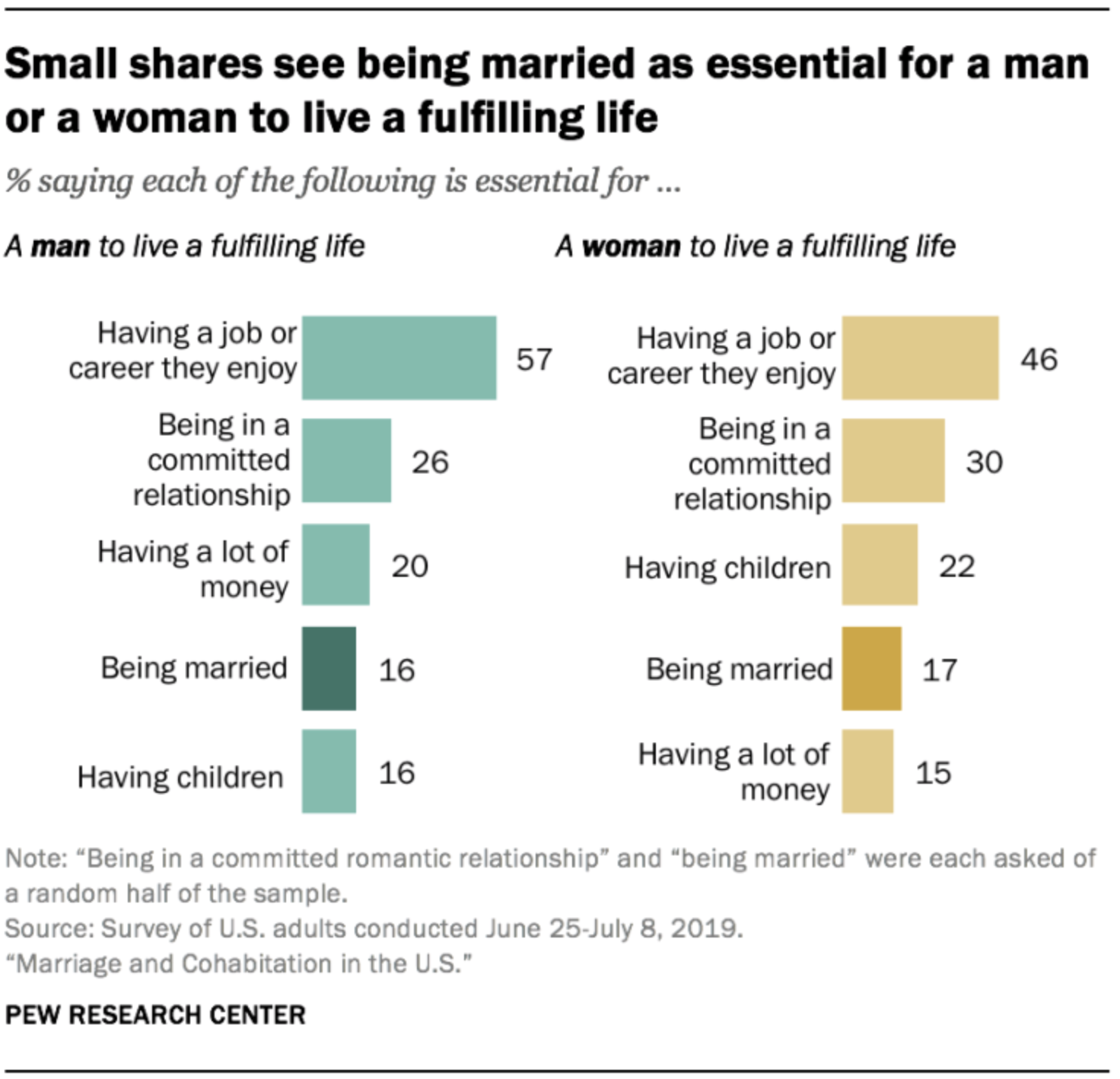
    Research from the “Pew Research Center” is almost always engaging, but the most recent study is really fascinating. Take a look at the below graph:


    Work is the #1 means to a fulfilling life for both men and women. I’m not surprised that men and women flip flop priorities on money and kids, but I am surprised that both sexes share the same goal with a career. This graph might shed some light as to why it’s not uncommon for a career to get 50-60+ hours a week of attention for men and women.

    The number one reason why I think work is center focused for so many men and women: Worth. We all have a desire to be worthy, to prove ourselves, and work checks all the boxes for making us to feel that way. Money for our work (money is a vote of value), encouragement for a job well done, recognition for success, and “close but not too close” relationships with coworkers. When home is stressful, work is a great escape.

  2. Multiple Sexual Partners and a Higher Rate of Infidelity

    Those who have had multiple sexual parters are more likely to participate in an affair. From this article, “For people who reported four or fewer lifetime sexual partners, the rate of infidelity in the current marriage dropped to 11%, while for those who had five or more sexual partners the number was nearly double (21%).”

    This data makes sense at so many levels. Culturally we have bought into the “try before you buy” mindset of marriage. This is actually a really good principle for dating and engagement, but not in regards to sexual compatibility. There’s an old quip that illustrates this pretty well: Getting married because of great sex is great, at best, for about 15 minutes a day … what are you going to do together for the other 945 waking minutes of your time together? Sexual compatibility is created over time, together.

    What we practice in private, we will live out in public. Sex and marriage requires living with clear boundaries. Practicing these boundaries in our single (private) life will set us up to live this in our married (public) life.

  3. Secrets and Sickness

    In his book, Telling Secrets, Fredrich Beauchner wrote this: “We are only as sick as our secrets.” Evil feasts on deception, little white lies, and truth twisters. People don’t give themselves to evil overnight, they do so in small doses over time.

    Some troubling and sobering news out this week on a very public Christian figure, John Crist. The popular comedian has cancelled his tour after reports of sexual harassment and manipulation of multiple women.

    I hesitated to mention this story today because I don’t know John. I’ve watched his funny videos on Christian culture, but I can’t speak about his character or what happened in these troubling stories. What I do know is that John is not all that different from you or I. We all have a capacity to do exactly what he has done, and worse. This story is a mirror for us to consider what is happening in our own lives.

    We all play hide and seek. We all need to be found out. We all need grace. And we all need to be confronted with the hurt and harm our secrets have had on God, others, and ourselves. Only then can the work of recovery happen.

  4. A Prayer

    My Lord God,
    I have no idea where I am going, I do not see the road ahead of me.
    I cannot know for certain where it will end.
    Nor do I really know myself,
    So the fact that I think I am following your will does not mean that I am actually doing so.
    But I believe that the desire to please you does in fact please you.
    And I hope I have that desire in all that I am doing.
    I hope that I will never do anything apart from that desire.
    And I know that if I do this, you will lead me by the right road.
    Therefore I will trust you always though I may seem to be lost and in the shadow of death.
    I will not fear, for you are ever with me,
    And you will never leave me to face my perils alone.
    ~ Thomas Merton, Thoughts in Solitude

The Viewpoint is a semi-weekly roundup of content I have come across throughout the week that is worth reposting. This content will often be an article or a book I’ve recently read, or something else that is of cultural significance. One of my good friends talks about the word “viewpoint” as nothing more than a view from a point. When we change our point of view (or sometimes the point of our view — which is a different issue altogether), we can see differently. Relationships grow when we are open to changing our view.

Confidence

When we talk about having confidence we’re usually referring to the feeling of being steadfast, solid, or steady in our decision/statement. We also use the word to describe telling someone something private or secret that we ask them to keep “in confidence.” 

Confidence comes from the Latin word which means to act “with fidelity.” When we are confident, we act out of faithfulness to what we know or believe to be true. 

In an act of confidence (or lack thereof), a really important question to ask ourselves is this: “To whom or what am I being faithful?” Is the action faithful to a value or morality that is internally held? Perhaps it is faithfulness a boss, parent, spouse, God, friend, or other authority figure? 

Often our lack of confidence is because we are acting with too much faith in what another person says, instead of finding out what it is that we believe needs to be said or done. The risky work for this person is discovering and acting upon what unique interests, beliefs, and needs they have.

When we are too confident in ourselves, it’s because we have lost faith and trust in others. We can’t rely on them, so we act and live in isolation so as to not be hurt or let down again. The maturing work for this person is to risk asking for help from others. 

Too much confidence in others will keep us from making our own decisions and discoveries.
Too much confidence in ourselves will keep us from making wise decisions and finding our need of others. 

Serving Time

Each day is full of potential. Usually this “potential” is beyond what we know to be possible. Potential successes. Potential failures. We sometimes wake up with great expectations, and other times with great dread. But we all wake up in the same position: Unable to change time. We can’t make it pass faster, or slower. 

There are two kinds of time: Chronos and Kairos. 

Chronos is about the chronological, the counting, or tracking of time. This is why we have clocks: To track, count, and measure. 

Kairos is about the actions or purpose we take in time. Opportunity. Criticality. Possibility

Each day we are faced with a decision about how we will serve the time we are given. Will we serve it chronologically in how we pass or track the time. Some times, it’s all we can do to just get through it. TGIF.  

Or will we serve it with opportunity and possibility? Purposefully. With hope and anticipation.

The great thing about this question of how will we serve time is that it doesn’t matter how we did or didn’t serve it yesterday, we get another choice today. 

Comfort

The word “comfort” comes from the Latin word which means “strengthen greatly.” We use this word to describe relief from distress more so than strength in our distress.

In Western culture, the majority of us have a variety of “things” that are comfortable. Comfort food. Comfortable shoes. A comfy sweatshirt. Comfortable friendships. Comfortable habits. Comfortable life.

But sometimes that which is of comfort is not all that helpful. Comfortable isolation. The relief of familiar thought about ourselves or others. The comfort of more food. The ease of sleeping in instead of getting up early to exercise. 

Discomfort is not typically on our menu of options we gleefully chose for our lives. Yet it is the discomfort that moves us to change, or causes us to do something different with our lives. 

Many times it is our comforts that keep us from becoming who God created us to be.

The Gospel of Porn

The allure and promise of porn is simple. It’s about acceptance. It tugs at our need to be saved. Rescued. Our need for salvation.

Porn says, “You can come as you are. You are welcome here. Alone. Tired. Afraid. Ashamed. No problem, You’re ok here.” 

Usually not really knowing what you are looking for, it promises to take care of you. 

It welcomes you. There is no judgement from anyone on the screen. No forgiveness needed because you are good and there is nothing wrong with your desires. Just keep searching, clicking, and watching. 

Porn holds you and tells you that whatever you are searching for, you can find it here. It whispers, “you’re not lost anymore.” This is the mastery of porn. It hits on a desire that we all have: To be found. Not lost anymore. Accepted. Welcomed with excitement and anticipation, without judgement, with open arms.

Porn offers no rejection. It always says: “Yes!” Accepting whatever you ask, faster than you can ask.

But in the end, you will leave. You’ll walk away alone. Tired. Afraid. Ashamed. Lost. Cold. And not ok.

Do you know what or who you’re searching for? 

_________________________________________

Pressure Treated Relationships

Pressure shows up two ways in relationships: Couples who put pressure on each other, and couples who have been have been pressure treated together. It’s the difference between an insecure relationship and a secure one.

Insecure relationships put a lot of pressure to “say or get it right” because the individuals aren’t yet good at taking care of each other. If one fails to “get it right” it’s known there won’t be much grace available. So they have to get it right, or bad things will happen. These relationships are marked by actions like tiptoeing around each other, avoidance of conflict, and a feeling of fear and shame. This is kind of like building a deck with untreated lumber. It’ll be fine until the fair weather is replaced with foul weather.

Secure relationships don’t have as much pressure to get it right, because they have gone through the “pressure treating process” from another source other than each other. This process is different for everyone. It could be the death of a loved one, therapy, mentoring, a common enemy, shared goal, mutually beneficial purpose together, or a surrender to marriage and God. Being pressure treated produces grace, mercy, patience, forgiveness, fighting for (not against), and most importantly: Belief in each other. When foul weather comes, pressure treated relationships stay strong and true. 

What type of relationship do you have?

Laundering Money

The only way finances can work in marriage is if it’s laundered first. Yes, you read that right. Launder your money. Clean it of ownership, of claim. Too many couples have split their financial assets, bank accounts, and credit cards.

A relationship based on earning says, “what’s yours is yours, and what’s mine is mine.” In this system, sharing household bills and common expenses works just fine as long as there is an abundance of money or abundance of agreement. Inevitably, the abundance goes away. “Fairness” changes over time, especially when one starts out earning their spouse.

Jealousy, resentments, and competition will grow in abundance when what is “fair” changes. When couples never financially marry each other, competition is bound to happen. Competition means that one person wins and the other loses.

Launder money so that when it’s done being washed, neither the husband or the wife know who’s money it is. It needs to be washed of individual ownership. The end result is: “We earned this.” Become teammates, not opponents.

In Process

Practice makes progress, not perfection. 

Voltaire said it so well, “The perfect is the enemy of the good.” 

We are all in process. Not fully baked. Not quite done. Some of us are almost, but not yet there. We are all learners in different stages of our own growth process. Only those who expect themselves to have already arrived will have little room for those that have yet to arrive. Themselves included. 

If we stop expecting perfection we might be so much happier with the results we get in life. Most importantly, we’ll be excited about ourselves, and others. Perhaps it’s time to set down the idol of the perfect, and accept what is good. 

One Thousand Words

Words are a gift for us to use with wisdom. Some of us have a lot of them, some of us don’t have all that many.

We use language to express thoughts, feelings, desires, ideas, and hopes. They are not all we have to communicate with, but they are the anchor of our communication. If we’re honest, we don’t measure our language with those closest to us.

If you only had a total of 1,000 words to use per day in your life, how would you use them? Who would you want to give them to (a blessing)? What kind of words would you want to use? What would you want to make sure you said?