Married Teens

What were you like when you were 13 years old? How were you as a kid when conflict happened in the family? Where did you go and what did you do to feel safe? What was your role in the family surrounding conflict?

Sometimes when conflict happens, we can become like a teenager again. We freeze up, fight back, run away, blame, stonewall, scream, mope, depress, and cry. I think everyone would agree that a thirteen year old does not do all that great as husband or wife. The reality is we all act like a teenager every now and then. 

What some 13 year olds need is a little bit of TLC, which is probably what you or your spouse needs when the “inner teen” shows up.

Try this: Get a picture of when you were 13, have it printed in a wallet sized print, and put it in your pocket. Do the same for your spouse. The next time you’re in a conflict, grab the picture of your 13-year old self (not your spouses picture!), and hold it up to your spouse. 

Talk to them about what’s going on with you. What does your “teenage self” need in this moment? What don’t “they” need to say or do? 

______________________________________
Use It Or Lose It

Relationships are like muscles, if we exercise them, they will grow (even if we don’t see that growth).

Marriage takes work, and will not naturally grow on it’s own. In fact, left alone, a marriage will shrivel up and die. It takes consistent time and energy much like your muscles.

If you were to sit all day every day for a year, you would notice a significant amount of atrophy in your body. Your inability to function after that year of sitting would likely take you a more painful and greater amount of recovery to return to your previous abilities (if ever at all). Once you have lost muscle mass, it is very difficult to get it back.

Your months and years of dating and courtship are very much like a daily trip to the gym. You exercised the muscles of the relationship that allowed it to grow. Though for a lot of us, when we married, we stopped going to the gym (literally and metaphorically!).

Continue your visits to the gym. Read books together, attend marriage workshops, go on dates, spend quality time together, give each other gifts, surprise each other with good things, and take trips. Do all of these things regularly and your marriage will thrive.

______________________________________

Avoiding Hurt Limits Intimacy

Couples that avoid hurt from happening (or the hurt that has already happened) are preventing intimacy from developing.

No one really enjoys being hurt, and being hurt is a part of all close intimate relationships. It’s going to happen. The difficulty is in viewing pain as though it is a gift, not the plague.

Pain is not fun, but neither is numbness. I don’t know about you, but when I leave the dentist after getting a shot of Novocain, I cannot wait for it to wear off. The feeling of not controlling half of my face is miserable (not to mention drooling and talking like there’s a boulder in half my mouth). People were not made to be numb, we were made to feel.

Mary Oliver penned this beautiful line, and it speaks well to the realities couples face: “I was once given a box full of darkness, it took me many years to realize that this too was a gift.”

Pain shapes our lives either in our acceptance of it or our refusal to experience it. Creating a space for hurts to be a welcomed guest in your marriage will serve you well. A noble calling for every marriage would be to create and live out a relationship that engages the hurt, and heals the pain.

Develop guidelines for how you’ll address hurts in your relationship. Setup a regular time to “clear the air” together, and keep short accounts. Find intentional ways to ask for and offer forgiveness.

______________________________________

Grace & Gratitude

Before I release a pre-marital couple to the wild world of marriage, I challenge them to adopt two words (concepts) as cornerstones for their marriage: Grace and Gratitude. Here’s why.

Showing grace implies forgiveness, acceptance, and a belief that your spouse is a better man/woman than what the offending action shows. It’s easy to get offended or hurt and turn away from them as protection. It’s hard to stay engaged and put hurt feelings aside and believe the best. Next time this happens in your relationship, offer grace by placing your hand on their shoulder or chest near their heart and say, “I don’t believe that you intended to harm me, and that you do love and care for me.” Watch what happens next. 

The second is gratitude. As a whole, we are not that grateful of a people. Instead, we are an entitled people. Sadly, I rarely encounter a couple that genuinely like each other. Most couples remember liking each other, but they’ve long since forgotten that part of their lives. Entitlements will destroy your relationship — Gratitude will repair and heal your relationship. 

Practice giving thanks to your spouse, for even the smallest of items.

  • “Thank you for smiling at me this morning.” 
  • “Thank you for sitting next to me on the couch.” 
  • “Thank you for turning off the TV and listening to my tough day.” 
  • “Thank you for marrying me.” 
  • “Thank you for smiling at me when I came home.”
  • “Thank you … <fill in the blank>”

 
It doesn’t take a lot to change the tune of your day, or your spouse’s day. Show them grace, and gratitude, and see how quickly you begin to like them again. 

______________________________________

Holidays and Rest

Christmas is upon us, and I wonder how you are doing in it all.

Rarely do I interact with people about the holidays and they share stories of rest as a main experience. Most say quite the opposite. There’s not enough time. Time is flying by this season. It’s so hectic. How am I supposed to get all of this done? 

There have been countless others that have written about the idea of Sabbath rest (these are three of my favorites: Heschel, Allender, Buchanan), so I won’t say what they have already said. But I do wonder what kind of rest you need today, or tomorrow, given how challenging this season can be for some. 

Family gatherings are stressful, and beautiful. Travel is full, and the destination offers something hopeful.

Work slows down for some, and speeds up for others. The weather is getting colder, and days are getting shorter. 

There’s so much happening around us, are you taking time to notice these things? Are you aware of the birds, squirrels, and geese as they flutter and bounce about in front of you? 

Perhaps five minutes is all you can spare in your day, and that’s ok. Take the five minutes, breathe, rest, and pause to listen for a moment. And then take 5 more minutes (unless there are cookies in the oven). It’ll be ok, there is plenty of time to get what can be done.

Have you gotten lost in the chaos of gifts, parties, and expectations? 
Have you lost your way?
What do you need help with, and from who? 
Are you well? 

______________________________________

Unknown

I’m sure you’ve heard someone say it, or perhaps that someone has been you, “I’m so afraid of the unknown.”

If you take a step back and consider that statement, it sounds pretty silly. How is it that you can be afraid of something you have yet to know? The answer: You can’t.

“I’m afraid of the unknown” is almost always a statement about fearing the known. Remember in Jurassic Park how the scientists filled in the Dino’s DNA gaps with frog DNA? It’s the same idea here. We have gaps in what we can know about the future, so we fill in those gaps with what we already know. You can’t be afraid of what you don’t know, so you fill the unknown with what you know.

Existentially, we humans are afraid of being out of control and not being a god. Practically, we’re afraid of being left behind, alone, betrayed, forgotten, and/or insignificant.

There’s no better place than the unknown to illuminate the fact that we humans are just humans. Fill it up with all your known fears, and you’ll never have to face what you don’t know. We’re not omnipotent. We don’t know everything. We’re limited. Fragile. Insecure. Capable of dying. And the unknown has all kinds of things that will hurt us.

And the unknown has all kinds of things that can help us find healing: New relationships. Different experiences. Finding God in new ways.

You should visit it sometime, the unknown is a pretty great place.

______________________________________

Comparison

Life is full of comparison. Babies are born, measured, weighed, and immediately placed in comparison with all the other records of babies born, “she’s 7 pounds 2 ounces, which is in the 67% percentile”.  Kids are measured at school based on test scores, and parents participate by asking their kids to be more like so-and-so. 

As if a life of comparison wasn’t enough, we double down and celebrate competition as one of the highest forms of success. While this works great on the field, it is an awful ingredient for home and work life. When there has to be a winner and a loser, everyone is a threat. Sometimes that includes ourselves.

Ultimately comparison results in two stances in relationships: Inferiority or superiority. Neither of those two kinds of people are enjoyable to be with. It’s either a bottomless hole of pity, or an untouchable pedestal of amazingness. The result: Everyone is looking at someone else to tell them if they’re ok or not.

Want out of the comparison rat race? Celebrate. Rejoice in the successes of others.

Celebrate the gifts, efforts, and attitude of someone (including ourselves), not just the results.

Celebrate them as a human being, not a human doing.

Be a cheerleader, not a critic. 

(And try not to compare how well you’re doing celebrating!)

______________________________________

Knowledge and Experience

There is a difference in the knowledge of reading about something, and the knowledge of experiencing something.

It’s the difference between the knowing in our heads and knowing from the heart. 

If you’ve been to the Grand Canyon, you know with your whole being the expanse of it all. There are no words to describe it. The grand scale of its depth is beyond what any wikipedia entry could ever help you to know if you’ve never been there. Yes, you can look at a picture, study the stats, and recount the history of how it came to be. But that will never get close to the experience one gets by standing on the South Rim.

This reminds me of the powerful scene in the movie Good Will Hunting when Sean confronts Will that not all things in life can be read in a book. 


What we know with our heads sometimes keeps us from believing with our hearts. We think we know something because we read about it or watched a Ted talk about it. We are inundated with pictures, data, and the expanse of words that tell us about things in life. Yet we’re impoverished in actually experiencing these same things. Things like adventure, love, taking a risk, forgiveness, healing, or sacrifice.

What might we find out about ourselves, or others, if we moved away from the comfort of knowing, to the comfort of experience? 

______________________________________

Practice Empathy

Empathy is the ability to imagine (or understand) what someone else is experiencing in their life. Authentic empathy is a huge ingredient in a close and impactful relationship. But how do we develop empathy? 

A quick Google search revealed pages and pages of tips for developing empathy, such as “Three steps to more empathy”, and “Do these twelve things to develop empathy.” If you want more steps than the one I’m going to talk about below, Google is your friend! 

There is only one way that I know how empathy is developed: You have to practice it.

As with anything that doesn’t come naturally to us, we have to practice it. You’re not good writing with your non-dominant hand? The only way to become better is to practice writing with it. 

Practice makes progress, not perfection.

Practice empathy in your car driving to work. Imagine the different stories that people are facing as they head into work. Try this: If someone cuts you off, or cuts in line, resist the finger or the outburst …instead, tell their story aloud. Perhaps they got a call that someone important to them is ill, or that their child was dropped off at the wrong bus stop. Those would be legit reasons to cut you off. 

Practice with people that you don’t know. Ask them questions that will help you understand what challenges they are facing.

Read a novel. Studies have shown that reading fiction exercises our empathy muscles as we get to look inside a character’s experiences that isn’t a threat to our own ego. (As an aside, the Ego is enemy of empathy. The two with fight against each other)

Your empathy muscle needs exercise. Exercise it to become empathically strong so that when you need it the most, you’ve got it.  

When we empathize we put our egos aside and share the space with equally important people. We’re all on this same planet, trying to do our best, working things out in our odd ways often times bumping or crashing into one another along the way. It’s messy, but it’s good.

Empathy makes space for everyone in the mess. How can you practice empathy today?

________________________________________

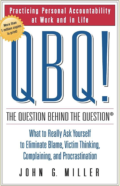
QBQ: The Question Behind the Question

Book Review for QBQ.
 
The Premise: If you’re asking the wrong questions, you’re not going to be able to solve the problems correctly. Personal accountability is achieved when we ask “what” and “how,” not “why” and “who.” Marriages thrive when those involved take responsibility by asking the correct questions about their situation. Ask, “how can I solve …” instead of “why did this happen.” 

My Take: This is an easy-to-read book that has great applications for our relationships. He really nails it by addressing the issues of personal accountability. As a culture, we’re far too consumeristic and “me-centric.” This leads to feeling like a victim and not taking responsibility for our actions. It’s just over 100 pages, with many chapters taking up less than two pages. Pick it up and read a few chapters, set it down. Read it out loud with your wife or husband. Spend fifteen minutes talking about it in the evenings. 

Application for Marriages: This is not a marriage 101 book, rather it’s a way of thinking about how and what we do in our relationships. There’s not a lot of practical advice for issues that would arise in a marriage, rather it helps to frame the approach we take in our response to these issues. Too often we get sidetracked with the implications of the questions or statements made to us. Instead we need to focus of what is behind the question or statement. 

______________________________