A Father’s Redemption

IMG-20130616-00470

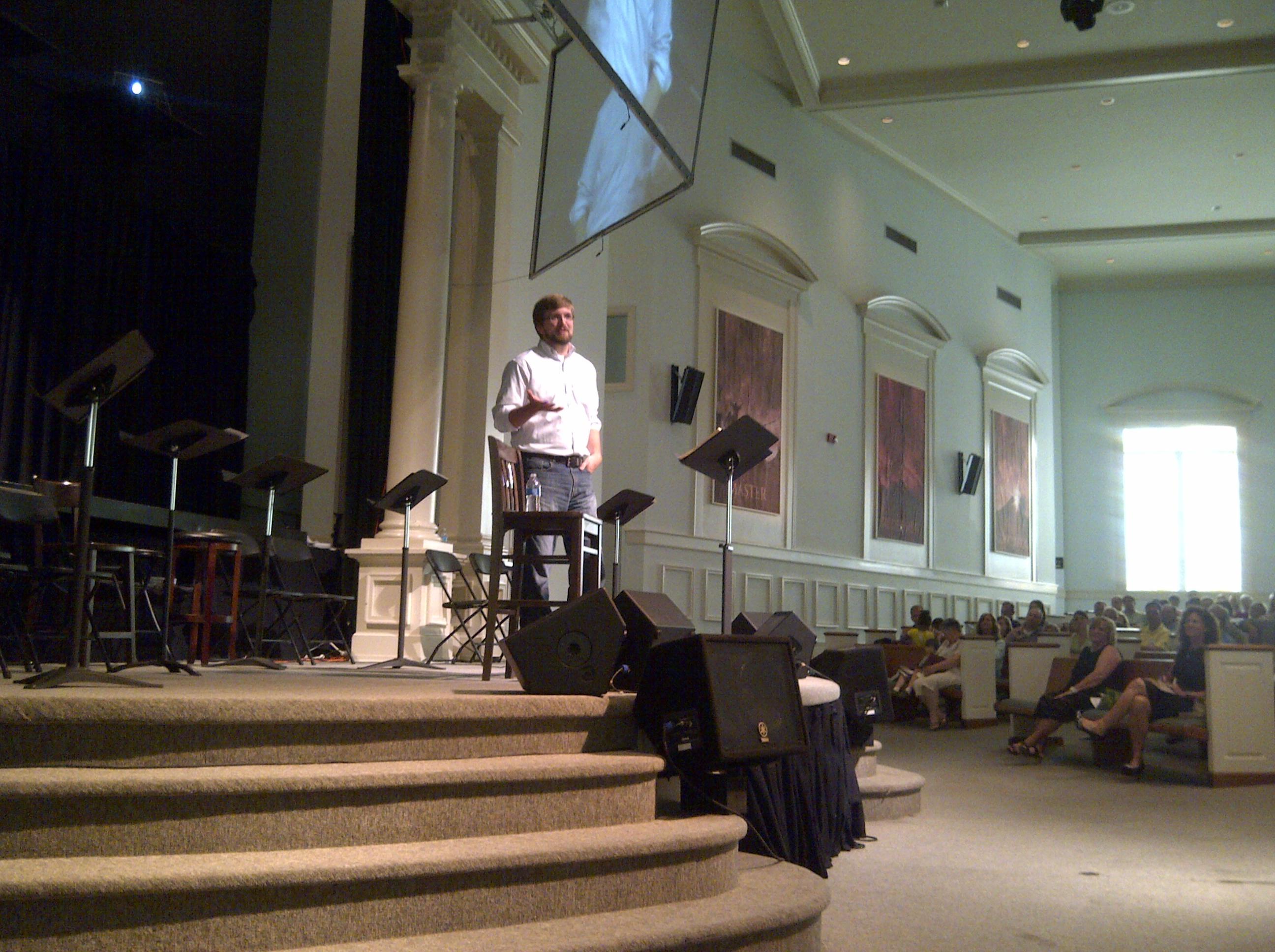
I was invited to be a guest speaker at Fourth Avenue Church of Christ this past Sunday on Father’s Day. I’ve spoken in many venues before, but it was a first for me to give the sermon in a church. I’m grateful for the opportunity and blessing of being able to share from my experience as a son and a dad to help cast a vision for father’s as they navigate the difficult waters of fatherhood.

There is a relational disconnect between a father and his children. For various reasons, this disconnect creates disharmony and obstacles as the children grow up to become adults. There are three roles that we as dad’s can play in our kids’ lives to not only raise them into adulthood, but also to ease the relational disconnect that exists. You can listen to the message here:

Click Here to Listen (35 minutes in length)

Two Words That Don’t Belong in Marriage

On average, women speak around 25,000 words per day. Men clock in at around 10,000 words per day on average. This is pretty fascinating in and of itself, and is great knowledge to have as you and yours navigate communication. Regardless if this is true of you and yours or not, of the thousands of words used on a daily basis, there are two that do not belong in marriage: Happy and Divorce.

These two words will erode the faith and trust that you will work so hard to establish in each other. I have worked with couples who use the word divorce like it was a trusted friend. It permeates their conversations and serves as a road block for them to ever get to the core of their marital problems.

The reason, among others, this word does not belong in relationships is that divorce is an act of destruction. There is no way to candy-coat the reality that is presented with a divorce. If you’ve ever built something and then torn it down or apart, you know that it takes a fraction of the time to tear down than it does to build. The same is true of marriage. It takes years and years of effort and energy to build a foundation of trust, love, and service but only a few moments of ill-timed action to destroy that which was built.

Don’t use “divorce.“ Too often I hear the word divorce used to manipulate and coerce. One of the couples I referenced above was so immune to the effects of this word that even the manipulation had worn off. My first advice to them: Eliminate the word divorce from their vocabulary. You cannot build something when the foundation or end result is in question.

Divorce may seem like an impossibility, but one look at the divorce rate will be sobering. As part of your marriage covenant and commitment, commit to never use the word divorce unless you are willing to follow through with what that means. By follow through, I mean to say that if you do use it you will act accordingly, and be accountable to your use. Do not use it as a threat. If you are hurt, lonely, angry, or sad, then speak to these emotions. Don’t hide behind a culturally acceptable way to escape from the pain and difficulty of life.

The other word that doesn’t belong in marriage is happy. Unlike the word divorce, happy is a word to describe a feeling and is usually not destructive in it’s use. The problem with the feeling of happy is that it’s unsustainable. There are moments and seasons of feeling happy, but it is not an attainable state of being. From a Christian standpoint, nowhere in the Bible are followers of God and Christ told that happiness is a result of faith. We are promised persecution, suffering, and sanctification, but not happiness.

Happiness is a symbol of mainstream culture and is often an idol. It’s an impaired state of joy. Happy is like being entertained and comes from consuming someone or something, whereas joy comes from the acceptance of our humanity and limitedness. Marriage is so heavily influenced by our culture that many get married with the belief, sometimes unconscious, that marriage will bring happiness.

“I’m not happy anymore” is the most common phrase I hear when couples separate and split up. It’s an epidemic. When people get married for happiness, they usually end up miserable or divorced. Disappointment on our own terms is much easier to deal with alone than with another person who was supposed to bring happiness.

Like setting a boundary for the word divorce, I encourage the same with the word happy. Instead of happy, use words like content, glad, joy, alive, desire, aroused, and passion. These all describe emotions that reflect a sense of being alive and awake to what’s stirring inside of us. The fulfilled life is not found through or in any man or woman today.

If it’s happiness you seek, do not get married. You will be disappointed. If it’s real joy, redemption, healing, and sanctification you seek, then marriage might be God’s place for you.

(This article was originally published at Start Marriage Right)

Worth Fighting For

A few years ago a couple came to see me to help with their sexual intimacy. They explained that sex was too infrequent and when they did make love, it was usually because they had been drinking. Further exploration revealed that though they had a very active sex life early in their relationship, the past two of their five married years have been very inactive. Sometimes they would go months without being sexually intimate.

I asked about what kind of disagreements and fights they have been in lately. They both looked at me, a bit confused, and exclaimed that they have never fought, nor do they want to. I wondered aloud if there was any connection between their sex life and their avoidance of conflict, to which they both said no.

It took this couple a couple of weeks to realize that the patterns of avoidance in their relationship had moved from the kitchen, to the living room, to the bedroom. It was impossible to be intimate in the bedroom because they were not being intimate in the kitchen. Intimacy on a daily, regular basis often times takes the form of conflict. When we speak up and risk exposing a desire, weakness, or vulnerability in ourselves, we are inviting another to see inside of us. This is the hard work of intimacy. For this couple, the lack of fighting created an enormous hole that slowly over time became too much to deal with on their own. Through some hard work and intentional truth-telling (sometimes conflictual), they were able to grow and learn to fight in a productive manner.

I share this story to highlight two aspects of conflict. First, everyone has an avoidance to some form of pain. For some it might be the pain of abandonment, for others it might be the pain of disapproval. Regardless of the source, conflict with a spouse will trigger this pain. Because everyone has a natural tendency to avoid pain, conflict becomes an unwelcome guest that stirs the pot.

Secondly, if conflict is not present, intimacy will not be either. It’s an unfortunate reality that intimacy requires us to show up and fight. Yet these are the vows that each and every couple commits to on their wedding day. “In sickness and in health” means that at all times I will choose to show up and be present, not just when it’s convenient.

I overheard a man telling his younger friend that he will know who he wants to marry when he is ready to crawl through ice, mud, glass, fire, and desert for 100 miles just to be with her. It’s a bit overblown as a metaphor (mainly because people do these events all the time around the US like the tough mudder, the viking race, and other crazy adaptations), but is an appropriate look at what kind of commitment it takes to be married. There will be moments in every marriage where this metaphor becomes a reality.

Fighting is a mandatory exercise to build connection and grow intimacy. Problems come when the fight gets unproductive by becoming dirty and cheap, stuck in the same cycle, or when it’s used to control and manipulate. When someone has chest congestion, a doctor wants to make sure that the coughing is productive so as to extricate the mucus and clear out the infection. This is what fighting is for in marriage: There’s an infection of personal wounds, selfishness, and other issues that need to be coughed up. Not just for the sake of coughing them up, but for the sake of the marriage and each partners’ individual growth.

Fighting, when productive, clears out the infections that we have relationally, and works to bring space and healing. Without these fights, the infection of disconnection will grow until there is no more relationship.

(article originally published at Start Marriage Right)
The Importance of Wise Counsel

Unfortunately, it’s a common occurrence. Boy meets girl, they fall in love, begin planning their life together, get married, and come home from the honeymoon expecting happy ever after. Then some kind of pain happens, and it’s as if these two people barely know each other.

I recently heard about a couple who is calling it quits after 15 months of marriage. They were young and ignored the counsel of friends and family to wait on marriage. They were encouraged to address some personal and relational issues. They didn’t listen and married anyway. These issues flared up and created too much of a block for reconciliation to occur.

After a little more than a year, it’s over. They didn’t plan on this happening, nor does any other right-minded person who is getting married.

One of my professors in grad school taught a class on domestic violence. She was the unfortunate recipient of years of abuse by her husband, which began on the honeymoon. She told her harrowing story. Upon arriving at their honeymoon beach house (the only house on this Canadian island) he told her that she was his property and that she’d better start doing what he said or she’d feel his wrath. He began physically and emotionally abusing her that day, and it continued for years. It’s a tragic story that repeats itself every day.

What we want to see in others can cloud us from seeing what is true about others. The engagement process gets so consumed with wedding plans that the relationship fails to grow or be seen for what it truly is.

At any point in your intimate or budding relationship wise counsel is your best ally. If the fatality rate of texting while driving a car was 50+%, I think that a majority of us would take heed at the importance of this stat and behave differently.

The sad reality is: This is true for marriage. The death of marriages happens at more than a 50% clip. The divorce rate offers a warning and caution that there is trouble ahead, and the outlook isn’t all that favorable.

Assuming that one is teachable, wise counsel might be the difference between a failed marriage and a successful one. Counsel comes from friends, family, professional counselors, pastors, authors, and proverbs. Surround yourself with people who will tell you the truth for the good of your soul. Friends that find no fault or see no areas that need growth in you or in your significant other are either being naive, or they are lying to you. Telling the truth is hard to do, especially when it potentially threatens a significant relationship.

Prior to getting married, my wife and I spent a couple of months with another couple who was 10-12 years ahead of us. They offered encouragement and some warnings about how our fights in marriage might play out. We were too “star struck” and in love to really understand what they were saying. Not until 6 to 8 months into marriage did we understand, and that was only because we fought daily about needs, wants, and expectations (all of which this couple had warned us about).

If you’re considering getting married, now is a great time to seek out a third party that can help you identify potential difficulties. Find a relationship coach, couples counselor, or pastor who is willing to walk through 4-6 sessions with you and your partner. Pre-engagement counseling is usually more effective than pre-married counseling because once a decision to marry has been made, it’s my experience that couples rarely hear the warnings heeded by others.

If your partner won’t go with you to counseling, this might be reason enough to not pursue a marriage relationship. Insecurities that prevent people from asking for help are always going to cause problems in relationships. Refusal to get or accept help is a sign of deep insecurity that will manifest itself in other, likely more harmful, ways. Proverbs 15:22 says, “without counsel plans fail, but with many advisers they succeed.”

(article originally published at Start Marriage Right)

Who Gets Your Best?

Shortly after getting the kids to bed, which sometimes is as late as 9:00pm, a usual occurrence is for my wife and I to retire to our separate desks. She to the home office, me to the couch. It’s been a long day, and we both need a breather.

Unfortunately, a lot of the time our “breathers” happen apart from each other.

It’s hard to muster the energy and strength to spend time engaging in a relationship after a long hard day fighting spreadsheets, meetings, customers, and expense reports. For my wife, it’s the exhaustion of four kids, each with their own unique way of depleting what little energy she has at the end of the day. So, after the kids go to bed, we’re done.

The two of us meeting together for a budget meeting? Fat chance.

Discussing our weekend plans? That can wait.

Pursuing each other sexually? Unfortunately, sometimes that too dips too much into the reserves.

It’s no wonder that marriages today are ruled by reality television, Facebook (which is referenced in at least one out of every three to four divorces today), and the insatiable appetites we all have for sweets. Ice cream, despite it’s glorious tastes (Häagen-Dazs® peanut butter chocolate, thank you very much), only lasts for a few minutes and usually leaves a full stomach, numbed feelings, and an empty heart.

With or without kids, life takes our energy. The simple becomes complex, and what once seemed so natural turns into the most laborious of tasks. To fight against the relational gravity, which is that mystical force that pulls and pushes us away from those we want to live life with, here are a few suggestions.

  1. Pursue sex before bedtime. Sexual intimacy is a major adhesive in keeping connections alive. Sex is easy, fun, and exciting in the early days of marriage, yet usually drifts to something more reminiscent of a chore or a responsibility. If one or both of you wait until all the TV shows are over and you’re both in bed to pursue a sexual connection, chances are one will be too tired. Rejections are inevitable when sex is initiated after bedtime.
  2. Declare some evenings to be media-free. At least 2 nights out the week, refuse to turn on the TV, log in to Facebook, or to play video games (on phones, TVs, computers). Instead use this time to discuss your week, reconnect sexually, read a book together, or to work on something together. If media is present in your home more nights a week than you and your spouse are, you’re marriage will suffer.
  3. There are three main conversations that must be discussed monthly: Money, Money, and Money. Take one evening a month and do a budget together. I suggest Sunday evening. Then at the beginning of the month, disburse the savings, cash, and pay the bills together. Each of you needs to be involved and in the know about where and how your money is spent. Together is better. Lastly, in the middle of the month, take a look at the first half of the month and review your goals. Talk about what you’re wanting to accomplish, where you need improvement, and what action steps you have for the last half.

Our best energies in the evening don’t automatically go to our spouse, they will usually go to ourselves. If we wait for the other person to bring about connection, both husband and wife will find something else to connect with, be it a TV, computer, or book. Be intentional about giving your best to your marriage.

(article originally published at Start Marriage Right)

Finding Light in the Darkness

(c) http://minnesota.publicradio.org/display/web/2013/04/20/news/final-shootout-in-boston
Celebrations in Boston after the news of the 2nd bombing suspect being captured.                                                                                Image curtsey of MN Public Radio.

Over the past week the people of this country have once again proven one of the most powerful human laws: Grief brings people together. This reality struck me on a number of levels last week as we watched an entire city be terrorized by two young men, a small town shaken by a tragic explosion, and a suburb locked down for almost 24 hours for a manhunt. I’m always amazed at how the experience of grief unites and connects people. No other experience matches it.

Each of these events, though two of them one of the same, brought to light the same story told over and over again throughout history. When people are unnecessarily hurting, we gather as friends, not enemies. We hug, cry, celebrate, and dance together.

Friday night after the second Boston gunman was caught, the celebration rang throughout the country. There were no party lines, no religious differences, and no declarations of morality. We were all united. United simply by the same goal we all share: To be treated fairly and respected. Tragedy breaks down walls.

I hate tragedy, but I respect it’s unjust place in life. We cannot keep it from happening, but we can keep fighting on behalf of good.

Tragedy doesn’t bring darkness, it invites light.

Tragedy says, “Look over here, I am broken, vulnerable, and afraid. I wish for peace, but cannot guarantee it for myself or my loved ones. Come some light, shine in the darkness and bring hope to this scary, uneasy, and very lonely place.”

In the end, tragedy exhausts the callused. Tragedy invites allegiance to the common good, the commonality that all humans share … the commonality that goes deeper than sexual preference, religious affiliation, or political party lines. Tragedy is an invitation. And in the end, tragedy is what fuels the sleepless nights on a manhunt.

Though I would never wish any semblance of human suffering to befall anyone, nor myself, I know of no other way to grow than through adversity. Adversity of the soul is the only way the soul is stretched, challenged, and matured.

Understandably, depending on where one is in the process of acceptance, the message that tragedy invites might be offensive. I too have felt this truth in my life because coming to accept my human finitude requires first that I find the end of myself, and thus find the beginning of Something larger, greater.

If you want to see “United We Stand” in action, visit a hospital waiting room. Atheists pray, grown men cry, enemies embrace, and the Tin Man gets his heart.

There are few experiences in this life that are as sacred as the grounds of grief. If you look closely, the light is ushering you to come forth from your hiding place to be welcomed and loved by friends and strangers alike.

Therapy as an objective sketch

realbeauty

I found this video on my Facebook timeline. As part of their “real beauty” campaign, Dove brought in a sketch artist to draw pictures of women based solely on their self-described features (the artist never saw the women). He then asked a stranger who’d met the women in the lobby to describe these same women to him. He then did a second sketch. The results are life changing.

http://www.youtube.com/watch?v=iswiKQbtwXQ&feature=share

This morning as I was reflecting up on this video I realized that there’s not a better way to describe the process of therapy. For all of us, we have an image, a sketch, of ourselves in our head. This image reflects both the physical and emotional makeup that we understand about ourselves. We live our lives operating out of this image, as if it were undoubtedly and unequivocally true. The problem is that our self-perception is often short circuited by shadows from the past. Because a name someone called us as a kid, or how someone took advantage of us in a perverse way all work to shape our perceived value and worth.

In a culture that is so highly motivated by appearance, we spend a lot of time and money fixing out outward selves to bring about love and respect from others. The belief many of us hold is that if we show what’s truly on the inside, we’ll be unloved and unwanted.

Therapy is the process of helping to integrate our self-perception and the perception of others. It’s an often difficult process because our self-perception is so well established that it takes time and trust to break down the walls. Therapy provides an objective sketch that contradicts the self-imposed ideals about who one is, how one looks, and what value they have. The results are life changing.

3 Components of a Good Listener


“I need you to listen to me with your eyes,” Stephanie, my wife, says as we’re discussing our upcoming weekend plans. Truth be told, I was in the middle of a project on my computer and didn’t want to stop.

“I’m listening, just keep talking,” I reply. She continues talking and then asks me for input about making a decision about our kids sporting activity. I hesitate, trying to recall the data from the previous 30 seconds. The reality was this: I wasn’t listening, I was just hearing her voice.

I’m a pretty typical male and have a really difficult time multi-tasking. This isn’t an excuse, it’s just a fact that I failed to be aware of in this moment. It’s not that I didn’t want to discuss our weekend plans, but I didn’t want to do it right then and there. Explaining this to her would have been helpful, and could have saved us multiple offenses.

Good listeners know and act on their limitations.
Knowing our limitations is the work of learning our own story and makeup of who we are. By knowing ourselves, we can plan and sometimes prevent situations from occurring that will hurt, trigger, or harm someone we care about. In the above situation, just by speaking up and requesting 5 minutes to finish my project would have saved my wife and I the time and energy of an avoidable fight. My limitation was that I do not multi-task well. Instead of proactively asking for this, we spent the better part of a day recouping from a five minute problem.

Good listeners ask lots of questions.
The basis for all relationships is built on the foundation of curiosity. If we are not curious people, we will not get to know others. Asking questions is a way that we can make sure that we understand and hear what the other person is attempting to communicate.

My 8 year-old daughter has a bit of flair for the dramatic and will often exaggerate a story (she’s a fantastic story teller, by the way). Sometimes when she’s recounting an offense, she will say something to the effect of “everyone hates me!” What she’s communicating is that she’s extremely hurt. If I were to react solely to her statement about everyone hating her, I’d likely miss the truth that she’s hurting inside. By asking questions, I’m able to hear what’s happening behind the outburst and get the truth about her.

This is true for all relationships. If we respond without clarifying the content and context, we will often miss the heart of the matter. Good listening behooves us to ask questions like, “tell me more.”

Good listeners act as recording devices.
If you’ve spent any amount of time watching one of the dozens of crime scene television shows likely you’ve seen a crime solved because of a clue seen or heard in the background of a recording. Replaying what you heard the other person say is a great way to clarify what’s being communicated. This might sound something like:

What I heard you say was that you feel disrespected when I ignore you. Is that right?”

One of the best ways that we can love someone is to show them that we are truly interested in hearing what they have to say. Not what we want to hear them saying, but what they are actually saying.

Good listeners develop and fine tune a third ear. The third ear is the one that listens to what is being said and what is not being said. This is the holy grail of listening: When one is able to know their own and the other’s story (limitations, gifts, abilities, etc), pay attention to the non-verbal cues, and ask questions. Good listeners make for great partners in life.

…article originally published at Start Marriage Right

I Never Got What I Wanted

Last night at Porters Call Evening of Stories, Luci Swindoll recited a poem written by a 14 year old. It’s a remarkable poem that speaks truth to all who are willing to listen. Enjoy, and be inspired to be present in your life.

It was spring, But it was summer I wanted,

The warm days, And the great outdoors.

It was summer, But it was fall I wanted,

The colorful leaves, And the cool, dry air.

It was fall, But it was winter I wanted,

The beautiful snow, And the joy of the holiday season.

It was winter, But it was spring I wanted,

The warmth, And the blossoming of nature.

I was a child, But it was adulthood I wanted,

The freedom, And the respect.

I was 20, But it was 30 I wanted,

To be mature, And sophisticated.

I was middle-aged, But it was 20 I wanted,

The youth, And the free spirit.

I was retired, But it was middle age I wanted,

The presence of mind, Without limitations.

My life was over.

But I never got what I wanted.

(HT: http://articles.chicagotribune.com/1989-02-14/features/8903050524_1_poem-letters-holiday-season)

Marriage & Separation

Oil and water, separate

It may be that the only way to truly identify and understand the depths to which one goes to get their way in marriage is to separate. Marriages are too codependent to allow for the truth of control and manipulation to be seen. Consistently doing life together and the closeness of this life doesn’t lend itself to self-correcting behaviors. It’s not that every marriage requires separation, but those that are separated have a unique ability to view and judge their own efforts in marriage apart from the obvious and usually clearer failures of their spouse.

Separation is the exercise of putting distance between two selfish people so that they can each address the log in their own eye without be able to see the speck in the others’ eye. In short, if allowed, separation is one giant mirror.

Unfortunately, most separations happen as a bridge, rather than a stop-gap, to divorce. Divorce is the easy, and by  no means is it easy, way to step outside of the inevitable and difficult pain that exists in marriage. The biggest issue  is divorce is an exit that rarely solves the problem. Sure, the pain will lessen and cease to be as it was, but it doesn’t circumvent selfishness or the reality that life doesn’t look like fantasy.

 So, if you’re separated or considering separation, get someone to walk through the process with you. Invite someone who will guide and help you to understand your own control issues, how your woundedness is influencing your relationship, or where you need help grieving the loss of your idea of marriage. Divorce may be inevitable, but don’t let it dictate personal growth.